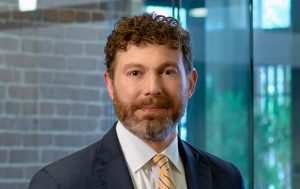

The Daily Journal has named John Keker, Bob Van Nest, and Elliot Peters 2026 Distinguished Counsel, which recognizes lawyers who have been among the publication's Top 100 Lawyers in California more than 15 times. The Daily Journal also named Sharif Jacob and Eric MacMichael among the 2026 Top 100 Lawyers in California, a prestigious annual list which "proves that judgment, preparation and persistence still define the very best." Below you can read The Daily Journal's profile of Sharif Jacob. You can also read profiles of John Keker, Bob Van Nest, Elliot Peters, and Eric MacMichael.
In April 2025, a federal court entered judgment for Netflix, closing out a patent campaign Broadcom had waged for five years. Broadcom had asserted 17 patents across two lawsuits and sought billions in damages. Sharif Jacob's team invalidated 13 of those patents through district court litigation and inter partes review, then won summary judgment on a remaining patent in January 2025, eliminating roughly 85% of the damages claim still in play. Broadcom Corp. et al. v. Netflix, Inc., 3:20-cv-04677 (N.D. Cal., filed July 14, 2020).
Broadcom dismissed the remaining patents. As Jacob put it, "It was a complete victory in an extraordinarily high-stakes dispute and showed how a disciplined strategy can dismantle a sprawling patent campaign."
Jacob has practiced for 18 years, joining Keker, Van Nest & Peters in 2008 after clerking on the Ninth Circuit. He was drawn to the firm's reputation for trying cases across subject matter, and that range still defines his docket. "In any given month I might be preparing for a patent trial, pursuing from insurance companies hundreds of millions of dollars of underpayments for emergency room care, or litigating the constitutional rights of transgender service members," he said.
A second matter from the past year: a whistleblower fraud case against Sutter Health, in which relators sought more than $500 million, alleging that certain anesthesia procedures and post-operative recovery-room care were unnecessary and fraudulent. After a seven-week bench trial, the court found no fraud, concluding the care was medically ordered, appropriate and supervised, and that Sutter's billing complied with industry standards. State of California, ex rel. Duncan and Hulbert v. Sutter Health et al., RG17846895 (Alameda Super. Ct., filed Jan. 25, 2017).
Jacob describes the challenge as one of narrative construction: "Our approach was to put the treating physicians at the center of the story: doctors had prescribed the care, it was medically necessary, the hospitals were entitled to bill for it."
Jacob is currently litigating a set of cases that will help define how courts regulate artificial intelligence. He represents NVIDIA against claims that training AI models on recorded voices violates Illinois' Biometric Information Privacy Act, against a separate class action alleging that training models on 3D objects violates the Digital Millennium Copyright Act, and against a music platform's claim that training on ordinary metadata constitutes copyright infringement. He also defends Meta in a patent dispute over AI voice-recognition technology, where his team moved the case from the Western District of Texas to Washington and moved to dismiss all asserted patents as invalid — a strategy that led to a settlement.
As Jacob explained, "Plaintiffs are filing suits that challenge the very business models that power AI. Because it's anew technology, the law is unsettled and regulation is a patchwork."
Jacob filed suit, alongside GLAD Law and the National Center for Lesbian Rights, challenging the Trump administration's denial of gender-affirming care to transgender service members and their relatives.
Outside his caseload, Jacob sits on the board of the San Francisco Community Health Center, which serves immigrants, communities of color and queer, trans and unhoused residents of the Tenderloin.
Reprinted with permission from the Daily Journal. ©2026 Daily Journal Corporation. All rights reserved. Reprinted by ReprintPros 949-702-5390.